
Table of Contents
- What Is Commercial Property Finance?
- Common Commercial Property Finance Structures
- Commercial Property Loan Deposits and LVR
- Low Doc Commercial Property Loans Explained
- Commercial Mortgage Interest Rates in Australia
- Application Process and Documentation
- Key Eligibility Criteria for Small Business Borrowers
- Tax Implications and Risk Mitigation
- Frequently Asked Questions
Last Updated: September 1, 2026
What Is Commercial Property Finance?
Commercial property finance generally refers to lending used to purchase, refinance or otherwise fund commercial property. The property may be occupied by the borrower’s business or held as an investment.
Assessment requirements vary between lenders and transactions and may include the borrower’s or business’s financial position, property type, rental income where applicable, available security, loan purpose and lender valuation.
Commercial finance structures, repayment arrangements, documentation requirements, fees and lender criteria vary and should be considered for the particular transaction.
Common Commercial Property Finance Structures
Commercial property lending may relate to owner-occupied premises or investment property. Lender policies, pricing, LVR limits, serviceability requirements and loan terms can differ depending on the property use and borrower circumstances.
Commercial lending may also be available with fixed, variable or other pricing structures depending on the lender and product. Fixed-rate and variable-rate arrangements can have different pricing, repayment, break-cost and flexibility considerations.
The availability and terms of any structure should be confirmed for the particular transaction.
Commercial Property Loan Deposits and LVR
Deposit and loan-to-value ratio requirements vary significantly between commercial lenders, property types and borrowers.
The LVR is generally calculated using the lender-assessed value of the property. A lender valuation below the purchase price may therefore affect the amount of finance available and the borrower’s required contribution.
Maximum LVRs, pricing tiers, security requirements and any applicable lender risk fees depend on lender policy and the transaction. They should not be assumed from a general percentage.
Deposit Adequacy Beyond the Purchase
Lenders assess whether you’ll have adequate working capital after purchase. A common rejection reason is insufficient operating reserves. Lenders typically want to see that after paying the deposit and settlement costs, you retain at least 3-6 months of business operating expenses in the bank.
Deposit Source and Timing
Lenders require evidence that deposit funds are genuinely yours. Bank statements showing the deposit amount for at least 3 months before application are standard. If the deposit comes from a recent gift, inheritance, or loan, lenders want documentation: a statutory declaration from the donor (gift), copy of will or probate documents (inheritance), or details of the loan (borrowed funds).
Strategies for Smaller Deposits
If you don’t have a full 20-30 percent deposit, options exist but come with trade-offs:
Mortgage insurance: Some lenders will lend at 85-90 percent LVR if you pay mortgage insurance (2-5 percent of loan amount, added to your loan balance). This allows you to proceed with a smaller deposit but increases total borrowing and monthly repayments.
Co-borrower or guarantor: Adding a co-borrower with stronger financial position or a personal guarantor can improve approval odds and sometimes reduce the required deposit.
Staged settlement: Negotiate with the seller for staged settlement, you pay part of the purchase price at settlement and the remainder 6-12 months later.
Asset-backed lending: If you have other assets (investment portfolio, property equity, vehicles), some lenders will consider these as additional security, potentially reducing the cash deposit required.
Low Doc Commercial Property Loans Explained
Low documentation commercial property loans simplify the application process by accepting less extensive financial evidence than traditional loans require. Instead of 2 years of full tax returns and detailed financial statements, lenders may accept recent bank statements, accountant’s letters, or simplified income declarations.
These loans suit established business owners whose circumstances have changed recently, contractors with variable income, or those needing speed. The trade-off is cost: low doc loans carry interest rates 0.5 to 1 percent higher than fully documented equivalents.
Commercial Mortgage Interest Rates in Australia
Commercial mortgage rates typically range from around 5.5 percent to 8 percent depending on the Reserve Bank’s official cash rate, lender competition, property type, and your loan-to-value ratio (rba.gov.au). Owner-occupied properties attract lower rates than investment properties. Your personal credit history, business profitability, and deposit size all influence the rate you’re offered.

commercial property insurance.
Application Process and Documentation
The commercial property finance application is a sequential process with distinct phases.
Phase 1: Pre-Application Preparation (Weeks 1-2)
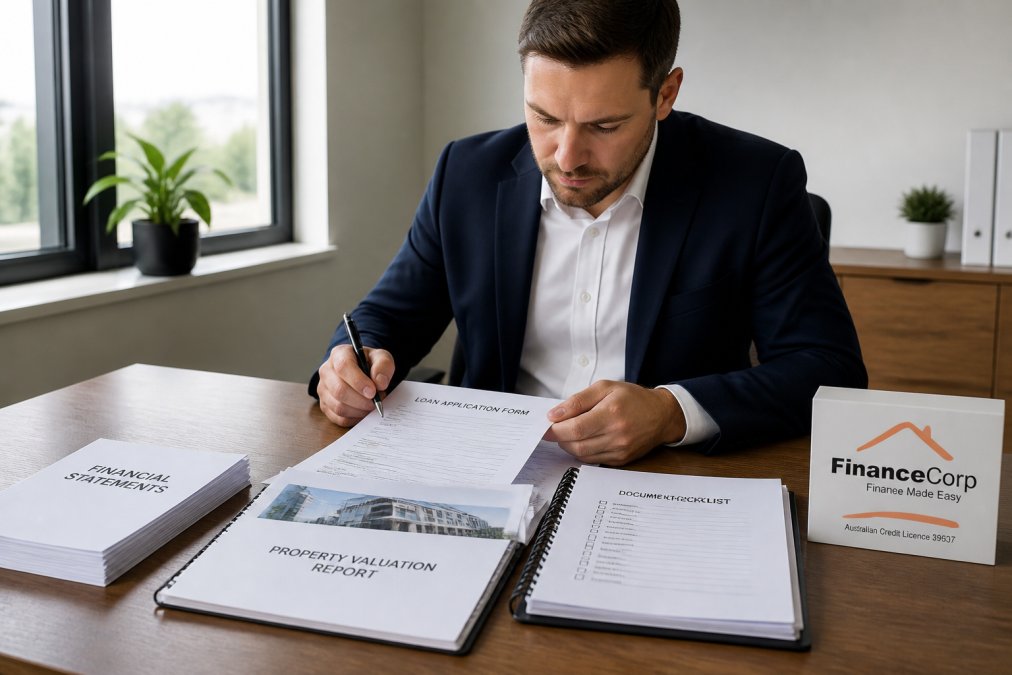
Gather 2 years of personal and business tax returns with notices of assessment from the Australian Taxation Office. If your business is newer than 2 years, provide recent bank statements showing consistent income deposits for at least 12 months. Prepare profit and loss statements and balance sheets for the past 2 years. Obtain bank statements showing the deposit amount held for at least 3 months. If the deposit comes from a gift or inheritance, obtain a statutory declaration from the donor. Compile a personal financial list of all assets and liabilities, and obtain your personal credit report.
Phase 2: Property Valuation (Weeks 2-4)
Once you’ve identified the property, arrange a professional valuation from a valuer registered with the Australian Property Institute. The valuer will inspect the property, review comparable sales, assess condition and income-generating capacity, and provide a written report. For a standard commercial property, this typically costs £800-£2,500. Understand that the valuation is independent of your negotiated purchase price.
Phase 3: Formal Application (Weeks 3-5)
Submit your formal loan application with all documentation. Include a cover letter summarising your business, the property purchase, and how the loan fits your business plan. For investment properties, provide a lease or letter of intent showing rental income. If your business is relatively new or you’re significantly expanding, include a detailed business plan outlining how the property acquisition supports growth and projected profitability for the next 3 years.
Phase 4: Lender Assessment (Weeks 4-8)
The lender’s assessment team reviews your application, typically taking 2-4 weeks. The lender will verify your income, conduct a credit check, assess serviceability, review the property valuation, and check the property’s title. Respond promptly to any requests for clarifications or additional information.
Phase 5: Approval and Conditions (Weeks 6-10)
If approved, you’ll receive a formal loan offer outlining the loan amount, interest rate, term, repayment amount, and conditions precedent. Common conditions include satisfactory title search, satisfactory insurance quotes, satisfactory legal review, and satisfactory employment verification. Your solicitor will handle most of these.
Phase 6: Settlement (Weeks 10-12)
Once all conditions are satisfied, the lender releases funds to your solicitor, who distributes them to the seller and pays all settlement costs. Total timeline from application to settlement typically ranges from 6-12 weeks.
Documentation Checklist
To avoid delays, ensure you have:
- ✓ 2 years of personal tax returns and notices of assessment
- ✓ 2 years of business tax returns and notices of assessment
- ✓ Recent profit and loss statements and balance sheets
- ✓ 3 months of recent business bank statements
- ✓ 3 months of recent personal bank statements
- ✓ Evidence of deposit funds (bank statements showing 3-month holding period)
- ✓ Personal credit report
- ✓ List of all assets and liabilities
- ✓ Professional property valuation
- ✓ Lease or letter of intent (investment properties)
- ✓ Business plan (if business is new or expansion is significant)
- ✓ Identification documents
Key Eligibility Criteria for Small Business Borrowers
Business track record typically requires at least 2 years of operation, though some lenders accept newer businesses with strong personal credit and substantial deposits. The business should demonstrate consistent or improving profitability.
Cash flow serviceability is critical. Lenders calculate whether your business generates sufficient income to cover loan repayments, operating expenses, and contingencies. Your income should exceed repayments by at least 25 percent (asic.gov.au).
Credit history matters, though it’s not the sole factor. A poor personal credit history can be overcome with strong business performance and a substantial deposit.
Loan-to-value ratio determines how much you can borrow against the property. Most lenders advance up to 70-80 percent of the property’s value.
Property type and location influence approval odds. Commercial properties in established business districts with strong tenant demand are easier to finance than rural properties or those in declining areas.
Security position means the property must be worth more than the loan amount. Lenders want certainty that they can recover their money if the business fails.
Tax Implications and Risk Mitigation
Interest paid on a loan funding an investment property is typically deductible against rental income. Interest on owner-occupied commercial property loans may be deductible if the property is used entirely for business purposes.
Depreciation on commercial buildings (excluding the land) can be claimed over 40 years, reducing taxable income (ato.gov.au). Capital gains tax applies when you sell the property. If held more than 12 months, you qualify for the 50 percent capital gains tax discount (for individuals).
Risk mitigation starts with conservative borrowing. Borrow only what your business cash flow comfortably services. Maintain adequate business insurance: public liability, property, and business interruption insurance protect your ability to service the loan. Diversify your tenant base if financing investment property. Review your loan structure periodically, if interest rates fall significantly or your business strengthens, refinancing can reduce costs.
Commercial property finance is a practical tool for business expansion, but it requires careful structuring and honest assessment of your capacity to service debt. The process demands more rigour than residential lending, but the flexibility in structuring repayments and the tax benefits make it worthwhile for the right business at the right time.
FinanceCorp’s team compares options from a panel of lenders, identifies the structure that best fits your situation, and manages the documentation and approval process. Whether you’re acquiring your first commercial property or refinancing existing debt, we simplify a complex process and ensure you understand every step. Enquire Today to discuss your commercial property finance needs with our team.
Frequently Asked Questions
How much deposit do I need for a commercial property loan?
Most lenders require a deposit between 20–30% of the property’s purchase price for commercial property finance. Some specialist lenders may accept lower deposits, particularly for owner-occupied properties or if you have strong cash flow and credit history. The exact deposit amount depends on your loan-to-value ratio, the type of property, and your financial position. Speaking with a broker who accesses multiple lenders helps you find options suited to your deposit capacity.
What documents do I need to apply for commercial property finance?
Standard documentation includes financial statements (balance sheet, profit and loss), tax returns (typically 2 years), bank statements, details of existing liabilities, and property valuation or contract of sale. For low doc loans, requirements may be reduced. Your broker will advise on the specific documents your chosen lender requires, ensuring your application moves forward smoothly without delays.
How do commercial mortgage interest rates in Australia compare to residential rates?
Commercial mortgage interest rates are typically higher than residential rates because commercial lending carries greater risk. Rates vary based on loan-to-value ratio, loan term, property type, and your business’s creditworthiness. Fixed rates offer certainty; variable rates fluctuate with market conditions. Working with a broker gives you access to multiple lenders’ current rates, helping you secure competitive pricing for your situation.
What is the difference between a commercial and residential property loan?
Commercial loans fund business properties or investment assets; residential loans fund owner-occupied homes. Commercial loans typically have higher interest rates, require larger deposits, shorter loan terms, and more rigorous financial assessment. Commercial lenders scrutinise cash flow and business performance more closely. Understanding these differences helps you choose the right finance structure and prepare realistic repayment expectations.