
Table of Contents
- What Is Business Debt Consolidation?
- How Does Debt Consolidation Work?
- Business Debt Refinancing Options Available to You
- Commercial Loan Eligibility Criteria to Know
- Small Business Debt Management Strategies After Consolidation
- Steps to Apply for a Business Consolidation Loan
- Tax Implications and Credit Score Impact
- Conclusion
- Frequently Asked Questions
Last Updated: August 18, 2026
What Is Business Debt Consolidation?
Business debt consolidation combines multiple business debts into a single loan with one monthly repayment. Instead of juggling payments to different lenders, you secure a new loan that pays off your existing obligations, leaving you with one creditor and typically one interest rate.
For small to medium-sized business owners, consolidation addresses a common pain point: cash flow fragmentation. Managing multiple loan repayments across different terms and interest rates makes forecasting harder and increases administrative overhead.
A common mistake is treating consolidation as a quick fix for cash flow problems. Consolidation reorganises existing debt, it doesn’t reduce the total amount owed or address the underlying spending patterns that created the debt. If your business is spending more than it earns, consolidation will mask the problem temporarily, then it returns.
How Does Debt Consolidation Work?
You identify your existing debts, calculate the total amount owed, then approach lenders with a proposal to refinance that total into a single facility.
The lender assesses your application using several criteria: your business’s revenue, profitability, cash flow position, and your personal credit history. They also review your debt-to-income ratio, the relationship between your total debt obligations and your annual income.
Once approved, the new loan funds are released and used to pay out your existing creditors in full. You’re left with a single loan agreement, a single interest rate, and a single monthly instalment schedule. The timeline from application to settlement typically takes several weeks.
After consolidation, your old facilities are closed. The monthly repayment is usually lower than the combined payments you were making before, because the term is extended and the interest rate may be more favourable. However, extending the term comes with a trade-off: you pay interest for longer, so total interest paid over the life of the loan may be higher.
Consolidation works best when your cash flow is tight but your business is fundamentally sound. If your business is losing money or heading toward insolvency, consolidation is a temporary patch, not a solution.
Business Debt Refinancing Options Available to You
When you’re ready to consolidate business debt, you have three primary pathways: unsecured business loans, secured finance backed by assets, and refinancing of existing facilities.
Unsecured business loans
An unsecured business loan is money lent to your business without requiring you to pledge any asset as collateral. The lender’s security is your promise to repay, backed by your business’s cash flow and your personal guarantee.
Unsecured loans are faster to arrange and involve no risk to your physical assets. However, they typically carry higher interest rates than secured alternatives because the lender has no asset to fall back on if repayment fails. They work well for consolidating trade credit, smaller equipment finance, or director loans, but are less suitable for consolidating large amounts of debt.
Secured finance and asset-backed lending
Secured finance requires you to pledge an asset, typically business property, equipment, or vehicles, as collateral. If you default, the lender has the right to seize and sell that asset to recover their money.
Because the lender has security, they’re willing to lend larger amounts and charge lower interest rates. This makes secured finance attractive when consolidating substantial debt. The trade-off is risk: if your business struggles and you can’t meet repayments, you could lose the asset you’ve pledged. Secured lending also takes longer to arrange, typically 4-6 weeks, because the lender must conduct a valuation and register their security interest.
Refinancing existing facilities
If you already have a loan with a lender and want to consolidate other debts into it, you can refinance that existing facility by increasing the loan amount and extending the term. Refinancing is often faster than applying for a new loan, because the lender already knows your business.
However, refinancing may trigger early exit penalties on your current loan. Always calculate the cost of early exit penalties before committing; sometimes a fresh application to a new lender is more economical.
Commercial Loan Eligibility Criteria to Know
Lenders evaluate business consolidation loans using consistent criteria. Understanding what they’re looking for improves your chances of approval.
Annual turnover. Most lenders require a minimum annual business turnover, typically between $100,000 and $250,000. Smaller businesses may struggle to find lenders willing to consolidate debt or may face higher interest rates.
Time in business. Most lenders prefer to lend to businesses that have been operating for at least two years. Newer businesses are seen as higher risk.
Profitability and cash flow. Lenders want to see that your business generates profit and positive cash flow. They’ll review your last two years of financial statements, tax returns, and business activity statements. If your business is barely breaking even or running at a loss, consolidation approval becomes unlikely.
Debt service coverage ratio. This is the relationship between your business’s cash flow and your total debt obligations. Lenders typically want to see a ratio of at least 1.25, meaning your business generates $1.25 in cash for every $1 of debt service.
Credit history. Your personal credit file and your business’s payment history matter significantly. A history of missed payments, defaults, or insolvency flags will make approval difficult. However, specialist lenders exist to serve borrowers with credit challenges, though they typically charge higher rates.
Director guarantee. Most lenders require you, as a director or ABN holder, to personally guarantee the business loan.
Some lenders will fast-track approval by skipping thorough financial assessment. Be cautious. If approval seems too easy, the interest rate is likely very high or the loan terms include hidden fees. Always compare offers across multiple lenders before committing.
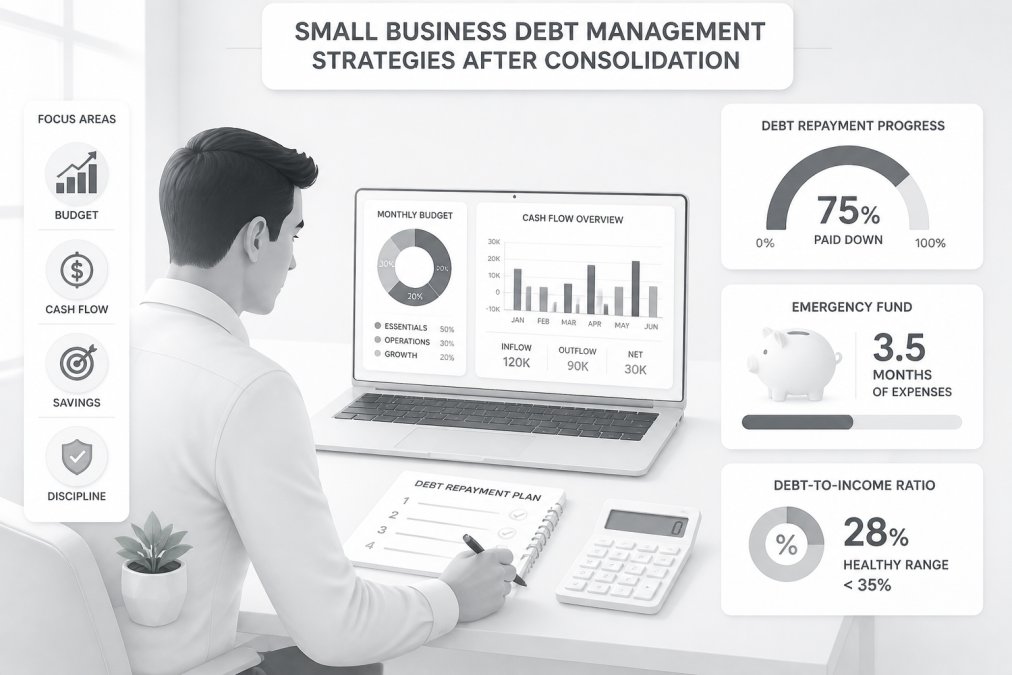
Small Business Debt Management Strategies After Consolidation
Consolidation is a reset, not a solution. The real work begins after the loan settles, when you need to prevent debt from accumulating again.
Build a consolidated budget. Create a monthly cash flow forecast that accounts for your consolidated loan repayment, operating expenses, and revenue. Many business owners find it helpful to work with an accountant or use accounting software to track this automatically.
Establish a debt repayment priority. Some businesses choose to pay down the consolidated loan faster by making extra payments when cash flow permits. Others focus on building working capital reserves first. However, making only the minimum payment means you’ll pay maximum interest over the loan term.
Control new debt accumulation. Many businesses end up consolidating again because they’ve started accumulating new debt while still servicing old debt. After consolidation, implement stricter controls on new borrowing.
Monitor cash flow weekly. Tight cash flow is often the reason consolidation becomes necessary in the first place. After consolidation, monitor your cash position weekly, not monthly. Early warning signs tell you that your business model needs adjustment.
Review supplier payment terms. If you’re consolidating trade credit, you’ve likely been paying suppliers slowly. After consolidation, negotiate better payment terms with key suppliers. Paying on time builds relationships and often unlocks better pricing or early-payment discounts.
Steps to Apply for a Business Consolidation Loan
The application process follows a predictable sequence. Understanding each step removes uncertainty and helps you prepare the right documentation upfront.
Step 1: Gather your financial information. Collect your last two years of tax returns, your most recent business activity statements, and a list of all current debts (lender name, outstanding balance, monthly repayment, interest rate, and any early exit penalties).
Step 2: Calculate your consolidation amount. Add up all debts you want to consolidate, plus any early exit penalties. Don’t overestimate; borrowing more than you need means paying interest on money you don’t use.
Step 3: Research lenders and compare offers. Compare at least three lenders before applying. Look at the interest rate, the loan term, any fees (establishment fee, ongoing fees, early exit penalties), and the lender’s reputation for speed and service.
Step 4: Prepare your application. Most lenders require a formal loan application, financial statements, proof of identity, and a personal statement explaining your business and why you’re consolidating. Be honest about any credit issues; lenders will find them anyway, and transparency builds trust.
Step 5: Submit your application. Once you’ve chosen a lender, submit your application along with all required documentation. Many lenders now accept online applications, which speeds up the process.
Step 6: Respond to lender requests. After submission, lenders often request additional information or clarification. Respond promptly. Delays at this stage slow down the entire process.
Step 7: Receive approval and loan offer. Once the lender is satisfied, they’ll issue a formal loan offer outlining the loan amount, interest rate, term, repayment schedule, and any conditions. Read it carefully before signing.
Step 8: Sign loan documentation. You’ll sign the loan agreement, possibly a personal guarantee, and a security agreement if the loan is secured. Your accountant or a lawyer can review these documents if you’re uncertain about any terms.
Step 9: Settlement and fund release. Once documentation is signed, the lender arranges settlement. On settlement day, the loan funds are released and used to pay out your existing creditors. Your old loans are discharged, and your new consolidated loan begins.

Tax Implications and Credit Score Impact
Consolidating business debt has financial consequences beyond the monthly repayment. Understanding the tax and credit implications helps you make a fully informed decision.
Tax implications. Interest paid on business debt is generally tax-deductible, meaning you can claim it as a business expense and reduce your taxable income.
However, if you’re consolidating personal guarantees or director loans, the tax treatment may differ. Director loans that are forgiven may be treated as income to you personally, triggering tax liability. Always discuss the tax implications with your accountant before consolidating, particularly if you’re consolidating director loans or if the consolidation involves any debt forgiveness.
If you’re consolidating ATO arrears (tax debt), the situation is more complex. The ATO has specific rules about how tax debt can be dealt with. Simply consolidating ATO debt into a standard business loan doesn’t make the underlying tax liability disappear. If you have significant ATO arrears, speak to a tax agent or the ATO directly about payment plans or hardship arrangements before pursuing consolidation through a lender.
Credit score impact. Consolidation affects both your personal credit file and your business credit profile.
When you apply for a consolidation loan, the lender conducts a credit inquiry. This inquiry appears on your credit file and can temporarily lower your credit score by a small amount (typically 5-10 points). This impact is usually temporary and recovers within a few months.
Once consolidation is complete, your credit score may actually improve over time. You’re replacing multiple debts with a single, well-managed debt. Your debt-to-income ratio improves. Your payment history on the consolidated loan will be positive if you make payments on time.
However, if you default on the consolidated loan or miss payments, the impact on your credit score is significant and long-lasting. A default remains on your credit file for five to seven years and makes future borrowing difficult and expensive.
The credit impact of consolidation is positive if you manage the new loan well, and severely negative if you don’t. Consolidation is only worth pursuing if you’re confident you can sustain the monthly repayment.
Conclusion
Consolidating business debt requires careful planning, honest assessment of your business’s financial position, and comparison of multiple lender offers. Expect 4-8 weeks from application to settlement, but the result is a simpler, more manageable debt structure.
At FinanceCorp, we help business owners navigate consolidation. Our team understands the complexities: the tax implications, the credit score impact, the lender criteria, and the long-term cash flow planning required to make consolidation work. With access to over 25 lenders and hundreds of loan products, we match your situation to the most appropriate consolidation option, whether that’s an unsecured business loan, secured finance, or refinancing of an existing facility.
If your business is managing multiple debts and cash flow is tight, consolidation may be the right move. Enquire Today to discuss your specific situation and explore consolidation options tailored to your business.
Frequently Asked Questions
Can I consolidate my business debt if I have poor credit?
Yes, consolidating business debt is possible even with a lower credit score, though your options may be more limited. Secured loans backed by business assets or collateral are often available to businesses with credit challenges. Lenders also assess your debt-to-income ratio, cash flow, and business viability alongside credit history. Speaking with a mortgage broker who accesses multiple lenders can help identify products suited to your situation, rather than applying directly to a bank that may decline you outright.
What is the difference between debt consolidation and refinancing?
Debt consolidation combines multiple debts into a single loan with one repayment schedule, simplifying cash flow management. Refinancing replaces an existing loan with a new one, typically to secure a lower interest rate or adjust the loan term. You can refinance existing facilities as part of a consolidation strategy. Both may improve your monthly cash flow, but consolidation specifically addresses the problem of managing multiple creditors and repayment dates.
How does business debt consolidation affect my credit score?
Consolidating business debt can initially lower your personal credit score if you hold a director guarantee, as the new loan application triggers a hard enquiry. However, consolidation often improves your score over time by reducing your overall debt-to-income ratio and simplifying repayments, making it easier to meet obligations on schedule. Business credit scores are separate from personal credit and improve when you maintain consistent, on-time repayments under the consolidated loan.
What types of business debt can I consolidate?
Most business debts can be consolidated, including trade credit, equipment finance, business overdrafts, director loans, and ATO arrears in some cases. Tax debts are complex and require specific lender criteria and potentially ATO agreement. A mortgage broker can assess which of your debts are eligible for consolidation and structure the best approach, particularly if you have mixed debt types or are managing financial hardship.